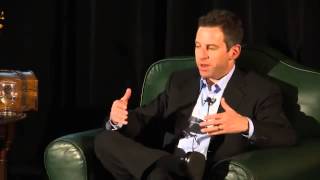
Sam Harris question and answer about his book
1,486 views (2014-10-22)Upload date: 2014-03-28⏱ 1:30:06👍 17 · 👎 0★ 4.86Education
Status on YouTube
not checked
not checked yet
Appeared on
Listed 83 times in captured pages, on 18 different lists (suggested videos, channels, playlists…). Earliest first:
- Channel page:
youtube.com/user/rationalstabs· capture of 2014-03-29 · nearest Wayback copy - Suggested next to: SAM 2337 · capture of 2014-04-14 · this capture in the Wayback Machine
- Suggested next to: Why Religion Should Be Replaced: Sam Harris on The End of Faith, Danger to Society (2005) · capture of 2014-04-14 · this capture in the Wayback Machine
- Suggested next to: Sam Harris Burns Down The House, In a Good Way ~ Women Who Write 2/25/14 · capture of 2014-04-29 · this capture in the Wayback Machine
- Suggested next to: Robert Wright interviews Daniel Dennett (full) · capture of 2014-05-09 · this capture in the Wayback Machine
- Suggested next to: SAM HARRIS (April, 2014) "The New Science of Morality" (MUST WATCH!!!) · capture of 2014-05-23 · this capture in the Wayback Machine
- Suggested next to: Neil deGrasse Tyson Public Lecture April 14, 2014 · capture of 2014-05-25 · this capture in the Wayback Machine
- Suggested next to: OkCupid - DarkMatter · capture of 2014-05-29 · this capture in the Wayback Machine
- Suggested next to: Peter Singer - The pond paradox · capture of 2014-06-05 · this capture in the Wayback Machine
- Suggested next to: Sam Harris interviewed by Andrew Marr for BBC radio (audio only) · capture of 2014-06-17 · this capture in the Wayback Machine
Description
Sam Harris question and answer about his book
Samuel B. Harris (born April 9, 1967)[2] is an American author, philosopher and neuroscientist, as well as the co-founder and CEO of Project Reason.[3] He is the author of The End of Faith, which was published in 2004 and appeared on The New York Times Best Seller list for 33 weeks. The book also won the PEN/Martha Albrand Award for First Nonfiction in 2005.[4] In 2006, Harris published the book Letter to a Christian Nation as a response to criticism of The End of Faith. This work was followed by The Moral Landscape, published in 2010, his long-form essay Lying in 2011, and the short book Free Will in 2012.
Harris is a contemporary critic of religion and proponent of scientific skepticism and the "New Atheism".[5] He is also an advocate for the separation of church and state, freedom of religion, and the liberty to criticize religion.[6] Harris has written numerous articles for The Huffington Post, Los Angeles Times, The Washington Post, The New York Times, Newsweek, and the journal Nature. His articles touch upon a diversity of topics, including religion, morality, neuroscience, free will, terrorism, and self-defense.[7]
In his 2010 book The Moral Landscape, he argues that science can help answer moral problems, and can aid the facilitation of human well-being.[6] He regularly gives talks around the United States and Great Britain, which include speeches at the University of Oxford, Cambridge, Harvard, Caltech, Berkeley, Stanford University, and Tufts University, as well as TED, where he outlined the arguments made in his book The Moral Landscape.[8] Harris has also made numerous television appearances, including interviews for Nightline, Real Time with Bill Maher, The O'Reilly Factor, The Daily Show, The Colbert Report, and The Last Word, among others. He also appeared in the documentary films The God Who Wasn't There (2005) and The Unbelievers
Tags
View history
watch pagelist (suggested, channel, search…)
Captures with a view count: 39 (the watch page and the lists that showed the video).
Archive captures (2)
| Captured | Source | Captured URL | Status | Views | Likes / dislikes |
|---|---|---|---|---|---|
| 2014-10-22 | Web Archive – pages captured in 2014 | youtube.com/watch?v=jRYDaFeb1dE&app=desktop | available | 1,486 | |
| 2014-04-16 | Web Archive – pages captured in 2014 | youtube.com/watch?v=jRYDaFeb1dE&gl=US&hl=en | available | 474 | 17 / 0 |
The captured URL is the exact address of the page when it was captured, country host and parameters included. For Common Crawl it opens the record in that crawl's index (WARC file and offset), and the HTML button downloads the page's original code from Common Crawl. For the Web Archive it opens that very capture in the Wayback Machine. The date of a Common Crawl capture opens the nearest Wayback copy of the page.