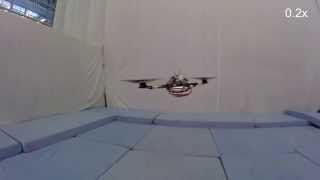
The Bicoptercopter: a preview
4 606 wyśw. (2018-11-15)Data publikacji: 2014-10-13⏱ 0:30👍 16 · 👎 0★ 5.00Science & Technology
Status na YouTube
nie sprawdzono
jeszcze nie sprawdzono
Opis
The Bicoptercopter -- Institute for Dynamic Systems and Control (IDSC), ETH Zurich, Switzerland - http://www.idsc.ethz.ch/
We have developed a novel type of flying vehicle, which uses multiple rotors spinning in the same direction. The vehicle body then spins in the opposite direction. The vehicle is only controllable because of its large angular momentum.
This technology is patent pending.
For more information, please see www.FlyingMachineArena.org.
Researchers:
Mark W. Mueller and Raffaello D'Andrea
Video:
Mark W. Mueller and Alex Wilkinson
Location:
Flying Machine Arena at ETH Zurich
Acknowledgements:
This work is supported by and builds upon prior contributions by numerous collaborators in the Flying Machine Arena project. See http://www.flyingmachinearena.org/people.
This work was supported by the SNSF (Swiss National Science Foundation).
Tagi
Zapisy w archiwach (1)
| Data zapisu | Źródło | Zapisany adres | Oryginał | Stan | Wyświetlenia | Łapki w górę / w dół |
|---|---|---|---|---|---|---|
| 2018-11-15 | CC 2018-47 | youtube.com/watch?v=csfAOCdkCdU | dostępny | 4 606 | 16 / 0 |
Zapisany adres to dokładny adres strony w chwili zapisu, z domeną krajową i parametrami. Przy Common Crawl prowadzi do rekordu w indeksie danego crawla (plik WARC i pozycja w nim), a przycisk „HTML” pobiera z Common Crawl oryginalny kod tej strony. Przy Web Archive adres prowadzi do tego właśnie zapisu w Wayback Machine. Data zapisu z Common Crawl prowadzi do najbliższej kopii strony w Wayback.