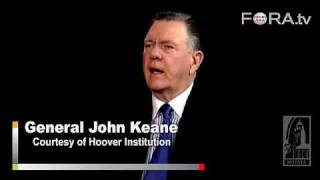
Reasons for Optimism in Afghanistan? - General Jack Keane
468 views (2009-09-27)Upload date: 2009-04-28⏱ 3:04★ 3.00 (17)News & Politics
Status on YouTube
not checked
not checked yet
In the archive: 2009-04-29 – 2010-01-27.
Sources: Web Archive – pages captured in 2009 · Web Archive – pages captured in 2010 · YouTube API 2009–2010 (ArchiveTeam crawl)
Download the statistics: CSV · JSON
Sources: Web Archive – pages captured in 2009 · Web Archive – pages captured in 2010 · YouTube API 2009–2010 (ArchiveTeam crawl)
Download the statistics: CSV · JSON
Appeared on
Listed 14 times in captured pages, on 6 different lists (suggested videos, channels, playlists…). Earliest first:
- Channel page:
youtube.com/user/ForaTv· capture of 2009-04-29 · nearest Wayback copy - Suggested next to: Empire - Obama and Afghanistan - Part 2 · capture of 2009-05-07 · this capture in the Wayback Machine
- Suggested next to: Bin Laden warns Obama of new fronts in global jihad · capture of 2009-09-27 · this capture in the Wayback Machine
- Suggested next to: Inside Iraq- US Sends More Troops to Iraq- Part 2- 12 Jan 07 · capture of 2009-09-27 · this capture in the Wayback Machine
- Suggested next to: Al Qaeda boss releases new video · capture of 2009-09-27 · this capture in the Wayback Machine
- Suggested next to: Does Affirmative Action Stigmatize Students? - Julian Bond and Dalton Conley · capture of 2010-01-27 · this capture in the Wayback Machine
Description
Complete video at: http://fora.tv/2009/03/25/General_John_Keane_The_Mastermind_Behind_the_Surge
Retired Army General Jack Keane gives his take on what he describes as the differences between the "good" Afghanistan war and "bad" Iraq war. Keane says that "there is not a major calamity in Afghanistan" in comparison to the crises of Iraq.
-----
During his thirty-seven years in the U.S. Army, Jack Keane earned four stars. Beginning his career as a paratrooper in Vietnam, he rose to command both the 101st Airborne Division and the 18th Airborne Corps. In his final post he served as the Army's vice chief of staff. General Keane retired from active duty in 2003.
In 2006, General Keane and military historian Frederick Kagan helped develop a new approach to the Iraq war that would become known as "the surge." How did we arrive at that point in 2006 when the entire war effort in Iraq hung in the balance why did the war go so badly for so long? General Keane gives an insider's account of this pivotal time in the Iraq war and of the resistance encountered within the military to that dramatic change in strategy. Keane discusses the lessons to be learned from the Iraq War and how to define and achieve victory in Afghanistan. Finally, he deals with the overall question of the military force structure and the danger of becoming preoccupied with the threat of terrorism and insurgencies and thus risking being unable to confront a conventional power. - The Hoover Institution
Gen. Jack Keane, ret. is senior managing director and co-founder of Keane Advisors, LLC, a private equity firm. General Keane has been elected to the board of directors of Metlife and General Dynamics. He is also a member of the Secretary of Defense's Policy Board, a member of the Council on Foreign Relations, and a director and member of numerous nonprofit organizations. Gen. Keane, a retired four-star general, completed 37 years in public service in December 2003, culminating as acting Chief of Staff and Vice Chief of Staff of the US Army. Still active in national security, Gen. Keane conducted multiple assessments of the security situation in Iraq for senior defense officials to include two visits in the last four months.
Peter M. Robinson is a research fellow at the Hoover Institution, where he writes about business and politics, edits Hoover's quarterly journal, the Hoover Digest, and hosts Hoover's television program, Uncommon Knowledge.
Tags
View history
watch pagelist (suggested, channel, search…)
Captures with a view count: 11 (the watch page and the lists that showed the video).
Archive captures (2)
| Captured | Source | Captured URL | Status | Views | Likes / dislikes |
|---|---|---|---|---|---|
| 2009-09-27 | Web Archive – pages captured in 2009 | youtube.com/watch?v=VOCSw0Dffbc&feature=channel | available | 468 | |
| 2009-07-30 | YouTube API 2009–2010 (ArchiveTeam crawl) | available | 427 |
The captured URL is the exact address of the page when it was captured, country host and parameters included. For Common Crawl it opens the record in that crawl's index (WARC file and offset), and the HTML button downloads the page's original code from Common Crawl. For the Web Archive it opens that very capture in the Wayback Machine. The date of a Common Crawl capture opens the nearest Wayback copy of the page.