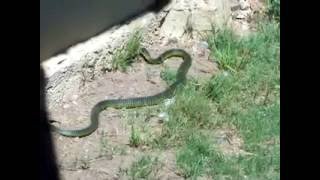
Savage Fight to the Death, Deadly Snake vs House Sparrow.
46,897 views (2017-04-25)Upload date: 2012-03-15⏱ 1:11👍 53 · 👎 21★ 3.86Pets & Animals
Status on YouTube
not checked
not checked yet
Description
Here we see two adult House Sparrows harassing a very poisonous Tree Snake (Boomslang), the Tree Snake is going to be getting into their nest to have a meal, the Sparrows try everything to stop the snake.
The boomslang (Dispholidus typus) is a large, venomous snake in the family Colubridae. Shredded skin of a boomslang is one of the ingredients to make the Polyjuice Potion in J.K. Rowling's Harry Potter and the Chamber of Secrets.
The average adult boomslang is 100-160 cm (3¼-5¼ feet) in total length, but some exceed 183 cm (6 feet). The eyes are exceptionally large, and the head has a characteristic egg-like shape. Coloration is very variable. Males are light green with black or blue scale edges, but adult females may be brown. In this species, the head is distinct from the neck and the canthus rostralis is distinct. The pupils of the very large eyes are round. The maxillary teeth are small anteriorly, seven or eight in number, followed by three very large, grooved fangs situated below each eye. The mandibular teeth are subequal. The body is slightly compressed. The dorsal scales are very narrow, oblique, strongly keeled, with apical pits, arranged in 19 or 21 rows. The tail is long, and the subcaudals are paired. Ventrals are 164-201; the anal plate is divided; and the subcaudals are 91-131
Tags
SnakewildlifeBirdsSpecialafricantreesnakeboomslangbirdprotectingnestdiestoprotectFeedingsuggested videoreptilesnake fightbird fightbird attacks snakesnake attackattackscarydangerfightfight to the deathflame frog videoflame frogboiling frog experimentsciencescience experimentboiled frogboiling frogrecpillingator oil
Archive captures (1)
| Captured | Source | Captured URL | Status | Views | Likes / dislikes |
|---|---|---|---|---|---|
| 2017-04-25 | CC 2017-17 | youtube.com/watch?v=LkzPyxR7VCc&feature=plcp | available | 46,897 | 53 / 21 |
The captured URL is the exact address of the page when it was captured, country host and parameters included. For Common Crawl it opens the record in that crawl's index (WARC file and offset), for the Web Archive that very capture in the Wayback Machine. The date of a Common Crawl capture opens the nearest Wayback copy of the page.