Wireless power transfer via inductive coupling
206,736 views (2017-02-24)Upload date: 2009-04-17⏱ 1:40👍 598 · 👎 12★ 4.92 (5)Science & Technology
Status on YouTube
not checked
not checked yet
In the archive: 2009-08-08 – 2018-11-21.
Sources: Common Crawl 2009-2010, 2012, 2013-20, 2013-48, 2014-23, 2014-35, 2014-41, 2014-42, 2014-49, 2015-11, 2015-14, 2015-18, 2015-22, 2015-27, 2015-32, 2015-35, 2015-48, 2016-07, 2016-30, 2016-36, 2016-40, 2016-44, 2016-50, 2017-09, 2017-17, 2017-22, 2017-26, 2017-51, 2018-05, 2018-09, 2018-17, 2018-22, 2018-47 · Web Archive – pages captured in 2009 · Web Archive – pages captured in 2010 · YouTube API 2009–2010 (ArchiveTeam crawl) · Web Archive – pages captured in 2013
Download the statistics: CSV · JSON
Appeared on
Listed 245 times in captured pages, on 202 different lists (suggested videos, channels, playlists…). Earliest first:
- Channel page:
youtube.com/user/computersolutions164· capture of 2009-10-07 · nearest Wayback copy - Suggested next to: Nikola Tesla - Wizard of Electricity · capture of 2009-11-23 · this capture in the Wayback Machine
- Suggested next to: IDF Research & Development keynote: Power Transmitted Wirelessly! · capture of 2009-11-24 · CC-MAIN-2009-2010 · nearest Wayback copy
- Channel page:
youtube.com/user/lpgas1· capture of 2009-11-27 · nearest Wayback copy - Suggested next to: BONES resonance test at the Biomechatronics Laboratory - University of California Irvine · capture of 2009-12-09 · CC-MAIN-2009-2010 · nearest Wayback copy
- Suggested next to: eCoupled Wireless Power-Simplify Your Life! · capture of 2009-12-18 · this capture in the Wayback Machine
- Suggested next to: Wireless Transmission of Electrical Energy Tesla Magnifying Transmitter Colorado Springs Research 3 · capture of 2009-12-26 · CC-MAIN-2009-2010 · nearest Wayback copy
- Suggested next to: Efficient Wireless · capture of 2010-01-01 · CC-MAIN-2009-2010 · nearest Wayback copy
- Suggested next to: eCoupled Technology Overview · capture of 2010-01-02 · CC-MAIN-2009-2010 · nearest Wayback copy
- Suggested next to: Wireless Energy Transfer · capture of 2010-03-26 · this capture in the Wayback Machine
Description
Note:
Schematics and information about the circuit is now available at 4hv.org:
http://4hv.org/e107_plugins/forum/for...
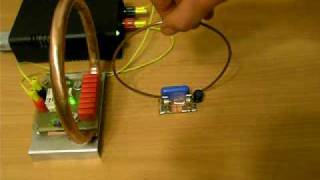
This is a small scale demonstration of wireless power transfer between two coupled parallel LC tuned circuits, each consisting of a copper conductor loop acting as an inductor and a capacitor. Both LC circuits are tuned to equal individual resonant frequencies. One of them is a part of a 1.5Mhz radio frequency oscillator powered by 12 volts DC, while another is loaded by a 24V 5W incandescent light bulb. Brought in proximity, copper loops share a small mutual inductance, essentially forming a transformer. In order to transmit significant amount of power through this transformer a very large amount of reactive power needs to circulate in it's primary, requiring use of a thick copper tube for the conductor, and a bank of eight 6.8nF capacitors in parallel.
Receiver coil's leakage inductance is in turn canceled out by another capacitor, allowing for the maximum power transfer to the load.
Experimenting with copper loop orientations, one can find positions of the receiver close to transmitter where no power is received, as total magnetic flux crossing through the receiver loop is zero. Hence this is a directional method of power transmission.
Due to small size of the apparatus very little power is actually radiated in far field, with losses being mainly ohmic heating. Hence this method is also sometimes known as non-radiative or near-field power transmission.
Tags
wireless powerwireless energyinductive couplingparallel resonanceLC circuitRoyer oscillatornearfieldnear fieldevanescent wave coupling
Other titles
- Wireless power transfer via...
View history
watch pagelist (suggested, channel, search…)
Captures with a view count: 115 (the watch page and the lists that showed the video).
Archive captures (30)
The captured URL is the exact address of the page when it was captured, country host and parameters included. For Common Crawl it opens the record in that crawl's index (WARC file and offset), and the HTML button downloads the page's original code from Common Crawl. For the Web Archive it opens that very capture in the Wayback Machine. The date of a Common Crawl capture opens the nearest Wayback copy of the page.